Binary Options Trading Glossary: Essential Terms Explained for Beginners

This binary options trading glossary explains the most important terms beginners must understand before placing their first trade.
From call and put to payout ratio, expectancy, drawdown, and risk management, each concept directly affects profitability in fixed-return trading.
More than 70% of beginners lose their first deposit within the first month, not because the market is unfair, but because they trade without understanding these core concepts.
Option trading has its own structure, logic, and terminology. Many new traders try to apply forex concepts such as stop-loss adjustments or position scaling. That approach does not work in fixed-return contracts. Once a position is opened, nothing can be changed. Risk and reward are defined in advance.
Because of this structure, terminology is not just vocabulary — it is risk control.
What Are Binary Options in Practical Terms
Binary options are fixed-outcome contracts. You predict whether price will be higher or lower at a predefined decision point (expiration). The size of the price movement does not matter. Only the final position relative to the entry level matters.
There are only two outcomes:
- predefined profit
- predefined loss
This simplicity makes the format accessible, but strict. Since trades cannot be modified after entry, preparation is critical.
Call and Put
Call means you expect price to close above the entry level at expiration. Put means you expect price to close below it.
Important clarification: you are not buying or selling the underlying asset. You are forecasting direction within a defined time window.
This distinction separates digital options from traditional position trading.
Expiration Time
Expiration is the moment when the trade outcome is determined.
In fixed-return trading, expiration defines the decision horizon. It cannot be changed after entry.
A mismatch between analysis and expiration reduces probability.
Example:Analysis based on a 15-minute market structure Expiration selected: 1 minute
This timing inconsistency increases randomness and lowers statistical reliability. Expiration alignment should always follow analytical logic.
Strike Price
The strike price is the entry reference level used to determine outcome.
Call → price must close above strike Put → price must close below strike
Simple in definition, critical in impact.
In the Money (ITM), Out of the Money (OTM), At the Money (ATM)
These terms describe the final status of a trade at expiration:
ITM → profitable trade OTM → losing trade ATM → equal close (rules depend on platform conditions)
These definitions are essential when calculating win rate and expectancy.
Payout Ratio
The payout ratio defines how much profit is received on a winning trade.
Example:
| Trade Amount | Payout | Winning Return | Losing Return | | $100 | 80% | $180 | -$100 |
With an 80% payout, breakeven win rate is approximately 56%.
Understanding payout mathematics is fundamental to long-term viability.
Fixed Risk and Fixed Reward
In this market, maximum risk and maximum reward are known before entering a trade.
You know:
- the maximum possible loss
- the maximum possible gain
This simplifies calculation but removes flexibility. Once the trade is active, it cannot be adjusted.
Win Rate and Expectancy
Win rate represents the percentage of profitable trades.
Example:
100 trades 58 winners Win rate = 58%
However, win rate alone does not determine profitability.
Expectancy logic (simplified):
(Win Rate × Average Win) – (Loss Rate × Average Loss)
Positive expectancy supports sustainable performance. Negative expectancy leads to capital erosion over time.
Professional evaluation requires large sample sizes — typically 50–100 trades.
Probability and Statistical Edge
Probability refers to the likelihood of a particular market outcome.
Statistical edge is a repeatable probability advantage confirmed over many trades.
Edge does not come from a single indicator. It develops through:
- context
- timing
- disciplined execution
- controlled risk exposure
Without edge, results revert to randomness.
Drawdown
Drawdown measures decline from peak account balance.
Example:
Balance increases from $1,000 to $1,200 Then declines to $1,050 Drawdown = $150
Managing drawdown is often more important than maximizing short-term gains. Excessive drawdown signals poor risk control.
Risk Management
A common professional guideline is risking 1–3% of account balance per trade.
This allows traders to withstand 8–12 consecutive losses without critical account damage.
In fixed-return trading, risk discipline stabilizes variance and protects longevity.
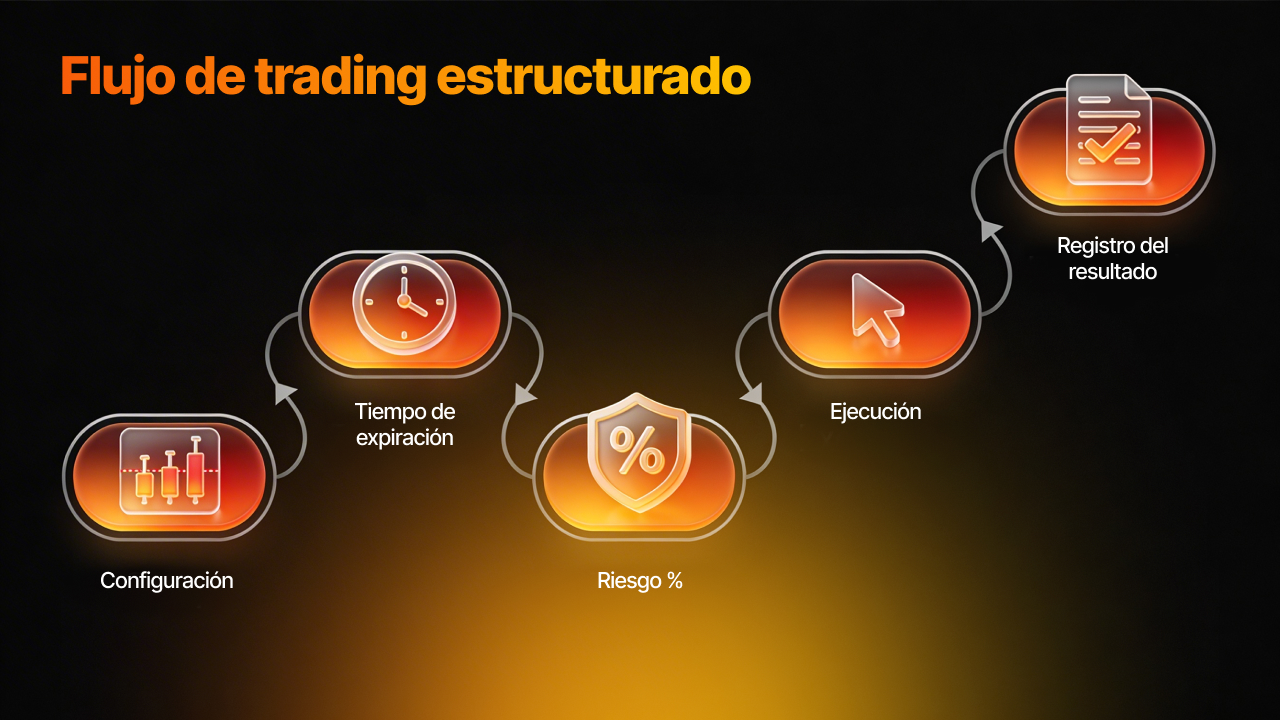
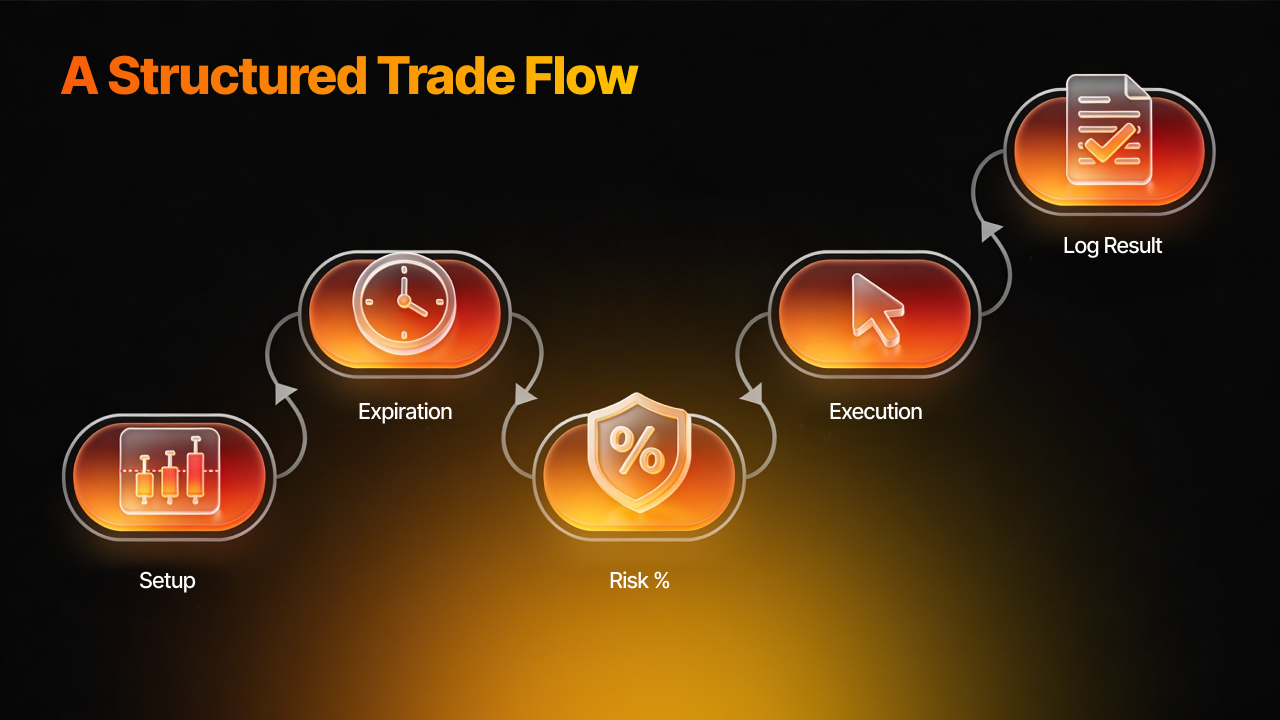
Structured Trade Pathway Example
A simplified decision flow:
- Identify direction on higher time frame
- Wait for pullback
- Confirm momentum shift
- Align expiration with structure
- Risk ≤ 3%
- Log the result
Structured execution replaces improvisation.
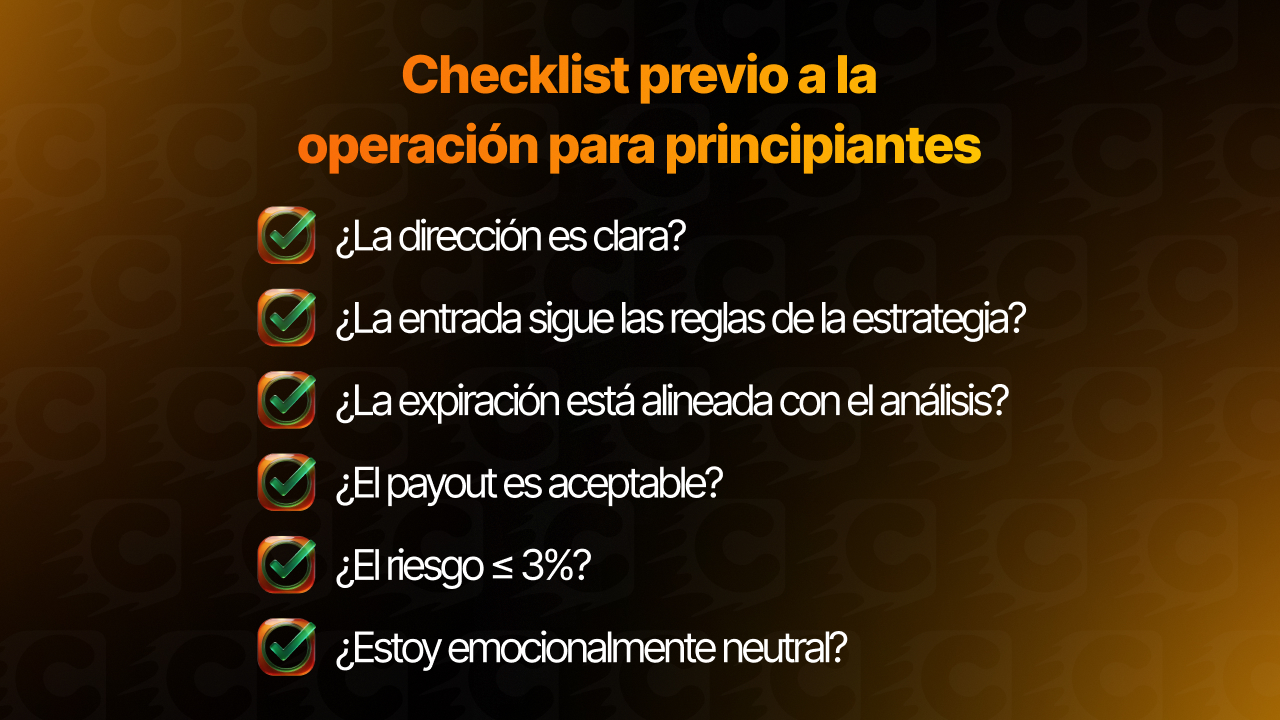
Beginner Checklist Before Entering a Trade
Before placing a trade:

Skipping low-quality setups improves expectancy.
Demo Mode and Structured Learning
Practicing in a simulated environment allows traders to:
- measure real win rate
- observe drawdown cycles
- refine timing
- test assumptions without capital exposure
On Cronika, demo access allows traders to explore option trading mechanics before risking real funds.
Indicators in Fixed-Return Trading
Indicators serve as context tools, not prediction guarantees.
They help:
- identify trend
- confirm momentum
- assess volatility
Common examples include RSI, moving averages, and Bollinger Bands.
No indicator creates edge independently. Structure and discipline do.
Common Beginner Mistakes
Early losses often result from:
- misunderstanding payout math
- choosing random expiration
- risking too much per trade
- overtrading
- chasing unrealistic accuracy
Most of these errors stem from weak conceptual understanding.
Why Terminology Directly Impacts Results
In this market, vocabulary equals structure.
Understanding payout influences expectancy. Understanding drawdown influences survival. Understanding probability influences discipline.
Without conceptual clarity, execution becomes emotional.
Conclusion
Fixed-return trading is simple in format but strict in consequence.
Every concept — from strike price to expectancy — directly affects performance.
Mastering the language of this market transforms option trading from guessing into structured, probability-based execution.
Consistency begins with understanding.
Disclaimer
Trading involves risk. This glossary is provided for educational purposes only and does not constitute financial advice.
Summary By AI
Binary options trading may look simple, but its structure is strict and rule-based. Every key term — from call and put to payout ratio, expectancy, and drawdown — directly affects how trades perform over time. Without understanding these concepts, beginners often confuse simplicity with safety and underestimate risk. In fixed-return contracts, nothing can be adjusted after entry. Risk and reward are defined in advance, which makes preparation and terminology critical. Profitability depends not on prediction, but on probability, statistical edge, disciplined execution, and controlled risk per trade.