Binary options trading strategies: a structured, numbers-based approach

Binary options trading strategies require a structured, numbers-based approach. Unlike discretionary trading, where decisions are often adjusted during an open position, successful binary options strategies depend on predefined rules, probability, statistical edge, and strict risk control. Every trade in binary options ends at a fixed expiration, which means results are not influenced by emotions after entry, but by the quality of the setup defined beforehand.
Because of this structure, key concepts such as win rate, payout ratio, expectancy, and drawdown play a central role. A strategy in binary options is not evaluated by one or two trades, but by performance over a series of trades. Even a strategy with frequent losing trades can be profitable if probability and risk parameters are aligned correctly. This is why binary options trading strategies are closer to statistical models than to intuitive decision-making.
Understanding these principles is essential before attempting to trade binary options consistently. Without a clear framework, binary options trading quickly becomes random. With structure, it becomes measurable and controllable.
What a binary options strategy really is
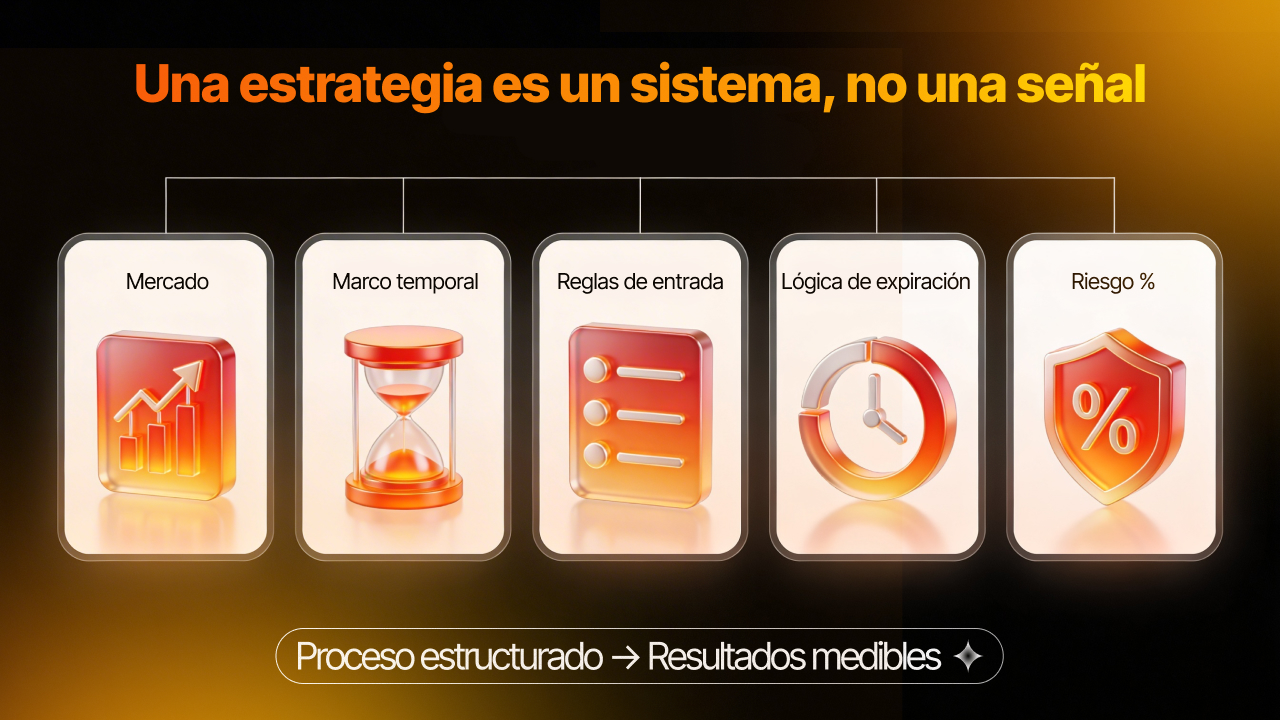
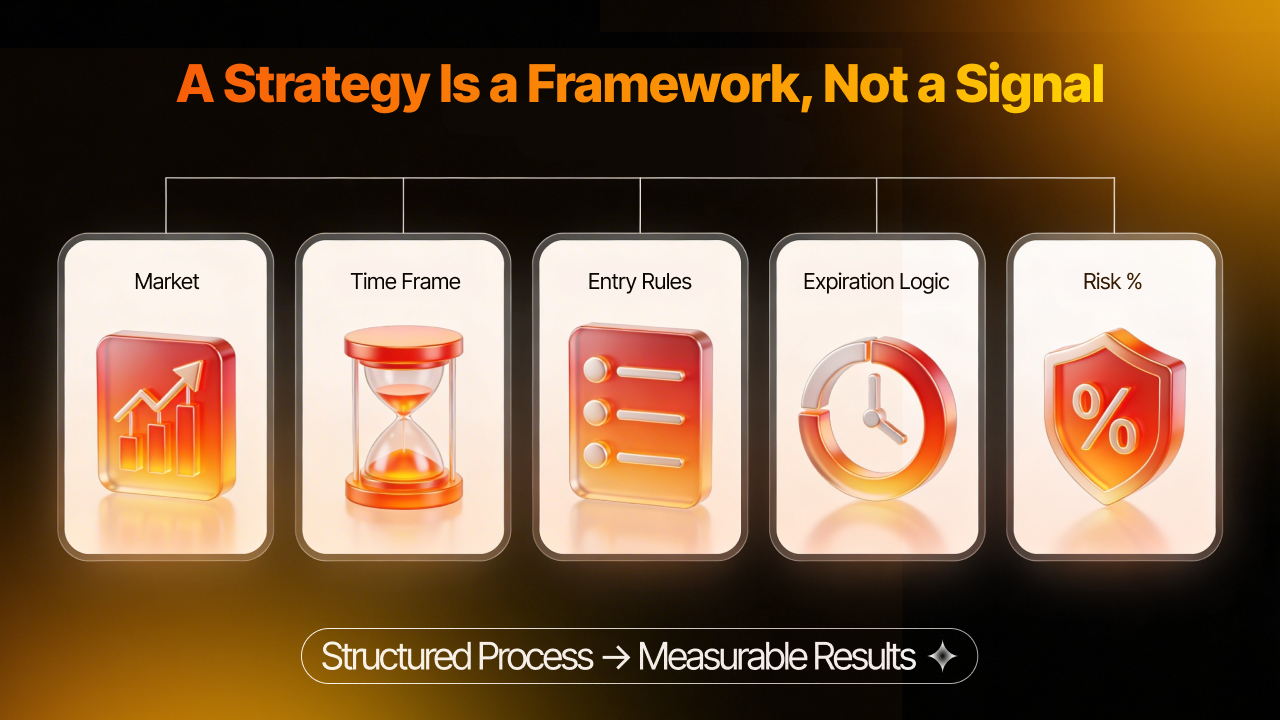
A binary options strategy is not an indicator and not a single signal. It is a repeatable decision-making framework designed to generate results over a large number of trades. The goal of a strategy is not to predict every market move, but to create a positive mathematical expectancy over time.
In practice, a complete strategy defines:
- the market and time frame used for analysis
- the direction in which trades are allowed
- precise entry conditions
- the logic behind expiration timing
- the percentage of capital risked per trade
When these elements remain consistent, results can be measured statistically. When they change from trade to trade, probability disappears and outcomes become random.
Probability, win rate, and expectancy in binary options trading

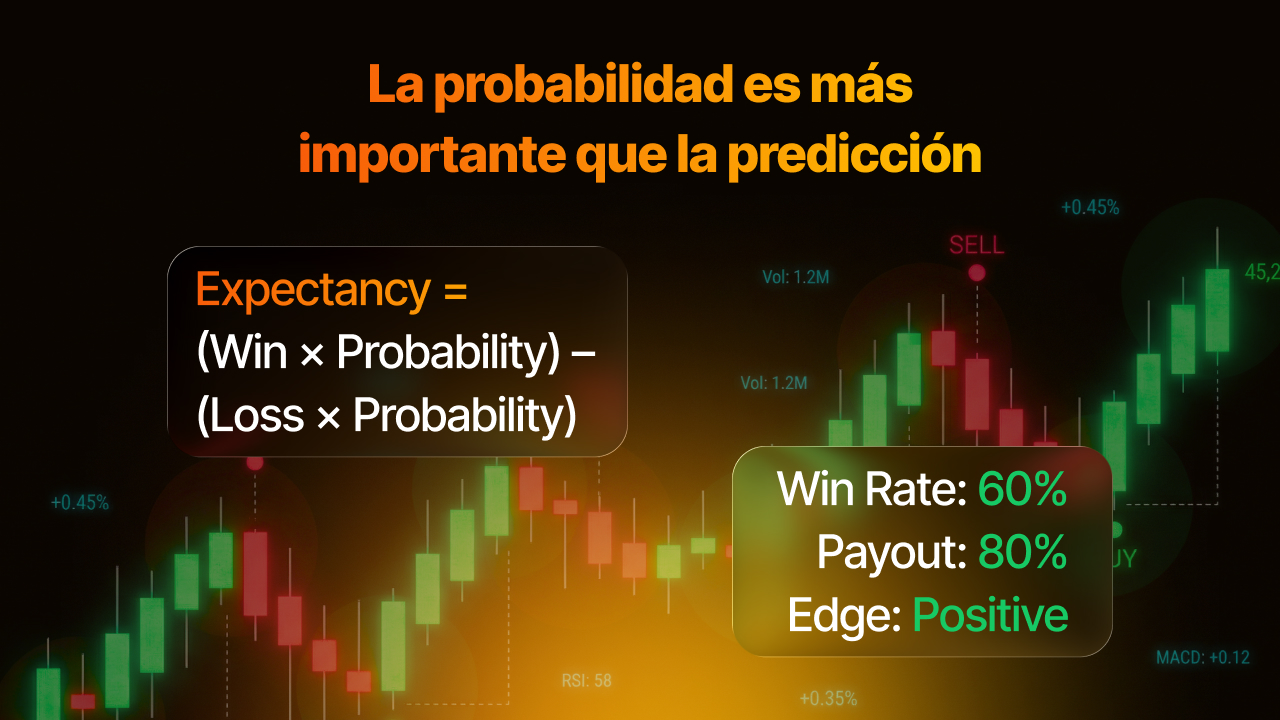
Binary options trading is a probability game, not a certainty-based one. No strategy wins all the time. What matters is the relationship between win rate and payout ratio.
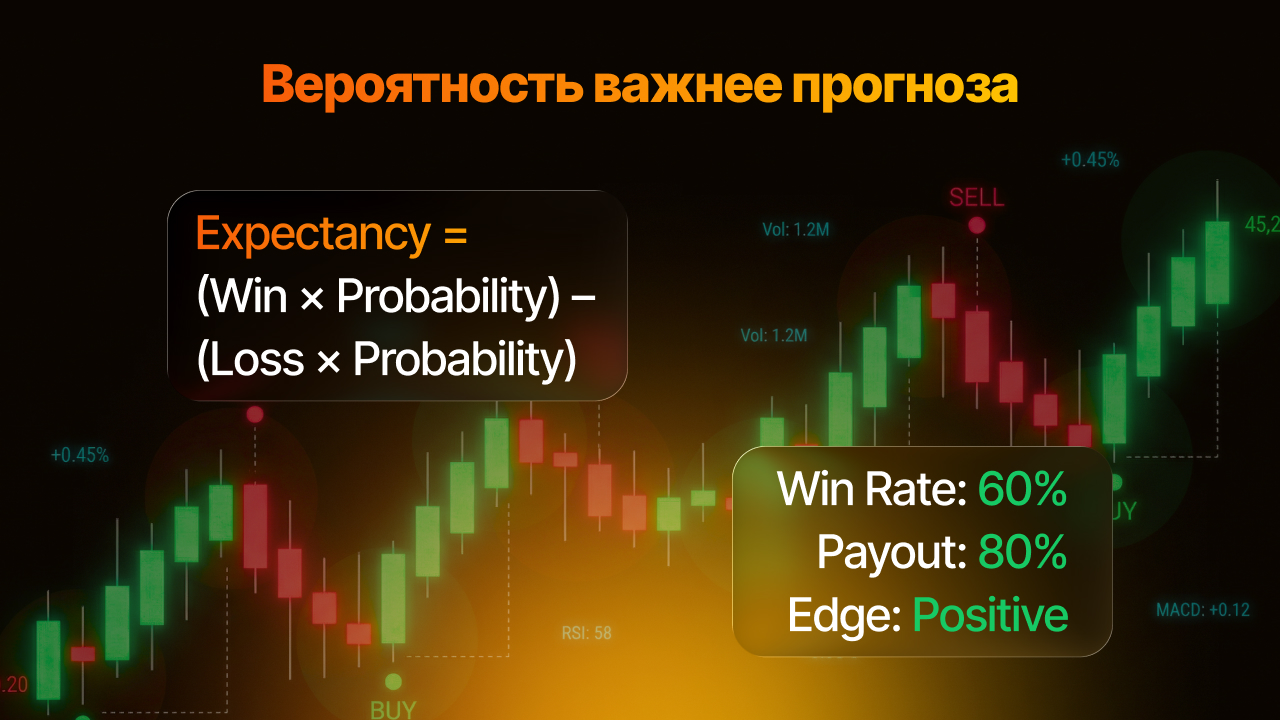
For example, if a platform offers an average payout of 80%, a trader needs a win rate above approximately 56% to reach breakeven before fees. Anything above that creates positive expectancy.
Expectancy can be simplified as:
- average win × win probability
- minus average loss × loss probability
A strategy with a 60% win rate and controlled losses can be profitable even with regular losing streaks. This is why evaluating performance over 50–100 trades is far more important than focusing on single outcomes.
Binary options risk management and drawdown control

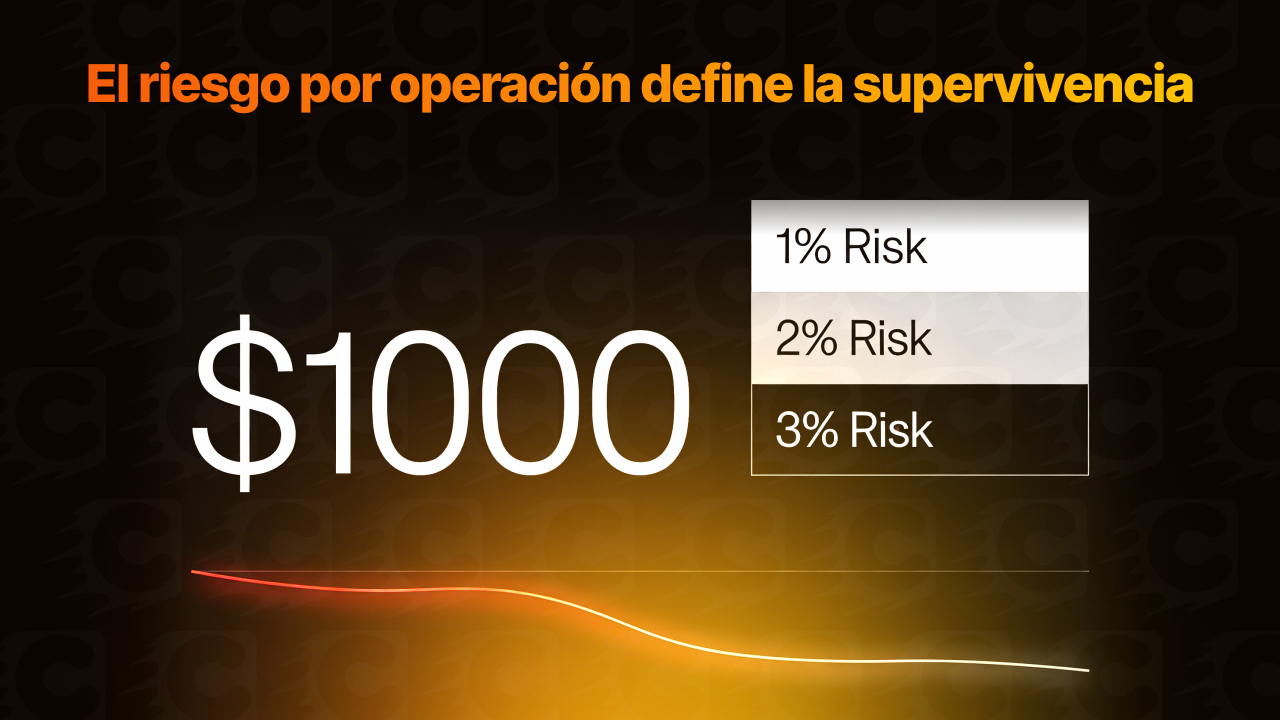
Risk management defines whether a strategy survives long enough for probability to work. In binary options, risk is fixed per trade, which simplifies calculations but increases responsibility.
A common professional guideline is risking 1–3% of total account balance per trade. Examples:
- $300 account → $3–9 per trade
- $500 account → $5–15 per trade
- $1,000 account → $10–30 per trade
With this approach, a trader can withstand 8–12 consecutive losing trades while keeping drawdown under control. Drawdown is unavoidable in trading, but it must remain statistically acceptable. Excessive risk per trade increases drawdown exponentially and destroys expectancy.
Many traders also limit activity to 3–5 trades per session and stop trading after 2 consecutive losses to prevent emotional escalation.
Trend-following binary options strategy with parameters
Trend-following remains one of the most statistically stable approaches in binary options trading because it aligns probability with market structure.
The trend is identified on a higher time frame such as 15M, 30M, or 1H. Entries are taken on a lower time frame only in the direction of the dominant trend.
Example setup:
- Asset: EUR/USD
- Trend time frame: M30
- Entry time frame: M5
- Condition: higher highs and higher lows
- Entry: pullback to local support with confirmation
- Expiration: 2–3 M5 candles (10–15 minutes)
This setup does not rely on large price moves. It only requires price to close in the expected direction at expiration, which aligns well with probability-based execution.
Range strategy and probability control
When markets move sideways, trend strategies lose efficiency. In these conditions, probability improves when trading reactions from clearly defined support and resistance levels.
A valid range should show at least 2–3 confirmed price reactions at both boundaries. Trades are taken only near these zones, not in the middle of the range.
Typical parameters include:
- Analysis time frame: M15 or M30
- Entry time frame: M5
- Expiration: 1–3 M5 candles, adjusted to volatility
Using expirations that are too short increases randomness and reduces statistical edge, even if the entry idea is correct.
Beginner block: building a statistical foundation
For beginners, the main goal is not profit but data collection and discipline. Trading multiple strategies or assets at the same time prevents accurate evaluation.
A structured beginner approach includes:
- one strategy only
- one or two assets
- fixed risk of 1–2%
- mandatory demo trading before live execution
Demo trading allows beginners to observe real win rates, payout behavior, and drawdowns without financial pressure. This stage is essential for understanding expectancy before risking real capital.
Starting capital and realistic expectations
Binary options trading does not require large starting capital. Many beginners start with $10–50 to limit emotional pressure and financial exposure.
At this stage, success is measured by:
- consistency of execution
- adherence to risk rules
- stability of results over 50–100 trades
Scaling capital before achieving statistical consistency often leads to larger drawdowns and loss of control.
Trade journaling and performance analysis
A trading journal is one of the most effective tools for improving expectancy. Recording each trade allows traders to calculate real win rate, average drawdown, and strategy stability.
A basic journal should include:
- asset and strategy
- time frame and expiration
- risk percentage
- result
Over time, this data reveals whether a strategy truly has a statistical edge or only appears to work in isolated cases.
Strategy execution on a trading platform
Execution must follow the same structured flow every time: asset selection, expiration choice, position sizing, strategy validation, and entry.
On Cronika, this process is linear and predefined. Trade conditions are fixed before entry, execution is automatic, and demo trading is available to test strategies before live deployment. This environment supports statistical evaluation rather than emotional decision-making.
Conclusion
Binary options trading strategies are built on probability, expectancy, and risk control — not on prediction. Win rate, payout ratio, and drawdown determine long-term outcomes far more than individual trades.
When approached as a statistical process with predefined rules, binary options trading becomes transparent and measurable. Without structure, it becomes random. Precision, discipline, and data are what separate consistent strategies from guesswork.
Summary By AI
Binary options trading strategies are built on structure, probability, and disciplined risk control. Success does not depend on predicting every market move, but on creating positive mathematical expectancy over a series of trades. Win rate, payout ratio, and drawdown management determine long-term results far more than individual outcomes. When risk per trade remains controlled and rules stay consistent, performance becomes measurable and statistically evaluable. Binary options trading becomes random without a framework. With predefined parameters, fixed risk, and systematic execution, it turns into a transparent, numbers-based process focused on consistency rather than emotion.