Can You Make Money With Binary Options? Realistic Profitability for Beginners

One of the most common questions new traders ask is simple and direct: can you make money with binary options, and is binary options trading actually profitable in real life?
At first glance, the structure looks extremely simple. You choose whether price will go up or down, set an expiration time, and wait for the result. Because of this simplicity, many beginners assume that earning money in binary options trading should be easy.
In practice, the situation is very different.
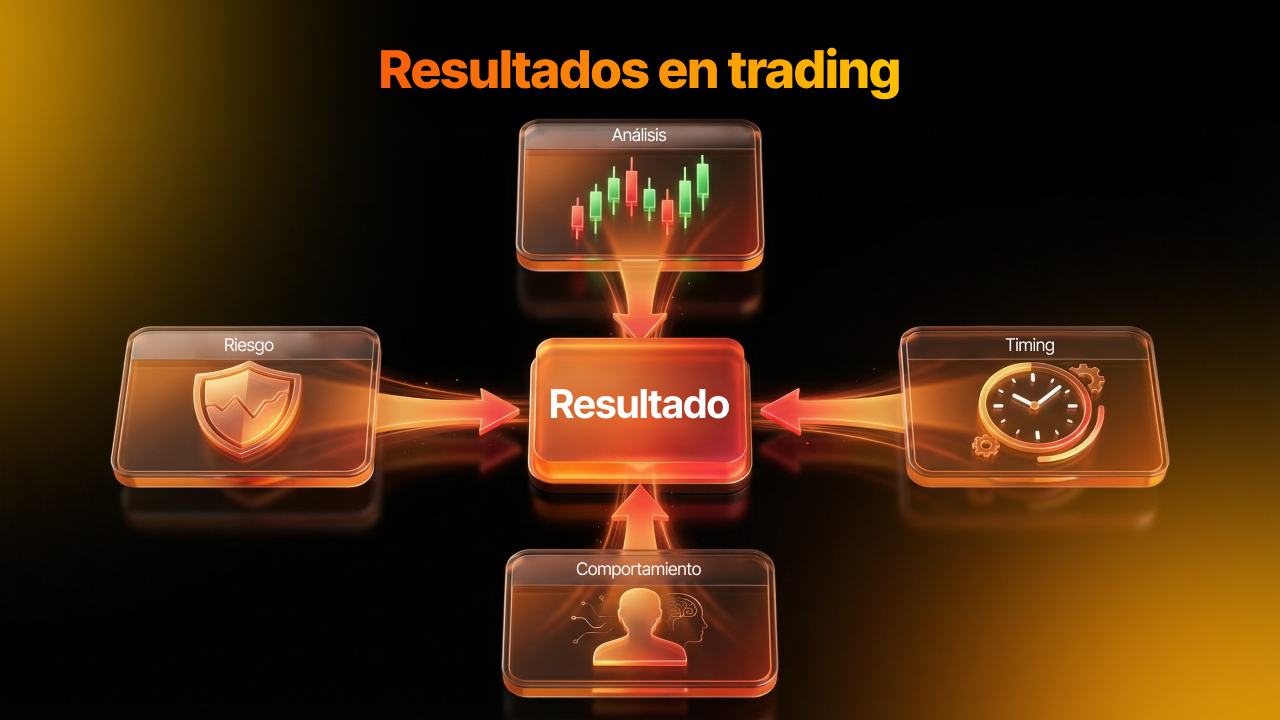
Yes — it is possible to make money with binary options. But stable profitability does not come from the simplicity of the instrument. It comes from how trading decisions are made, how risk is controlled, and how consistently a trader follows a structured process.
If you are just starting, it is important to first understand how this market works before focusing on profit expectations (What are binary options trading and how does it work)
Binary options trading is not about guessing direction. It is about probability, timing, and execution.
How Binary Options Trading Actually Generates Profit
To answer the question “is binary options trading profitable”, you need to understand the mechanics behind profit.
Binary options operate on a fixed payout model. Every trade has a predefined outcome. You know in advance how much you can earn and how much you can lose.
Example:
Trade amount: $100 Payout: 80%
- Winning trade → $180 total ($80 profit)
- Losing trade → -$100
This creates a structured relationship between:
- win rate
- payout ratio
- risk per trade
Most beginners focus only on winning trades. In reality, profitability depends on how these three variables interact over time.
Binary Options Profitability Explained: Payout, Breakeven and Expected Value
To fully answer “can you make money with binary options”, you need to look at the numbers.
Binary options trading is one of the few financial models where profitability can be calculated very clearly.
Payout Ratio and Its Impact
The payout ratio defines how much profit you receive from a winning trade.
Higher payout → lower required accuracy Lower payout → higher required accuracy
This directly affects how difficult it is to be profitable.
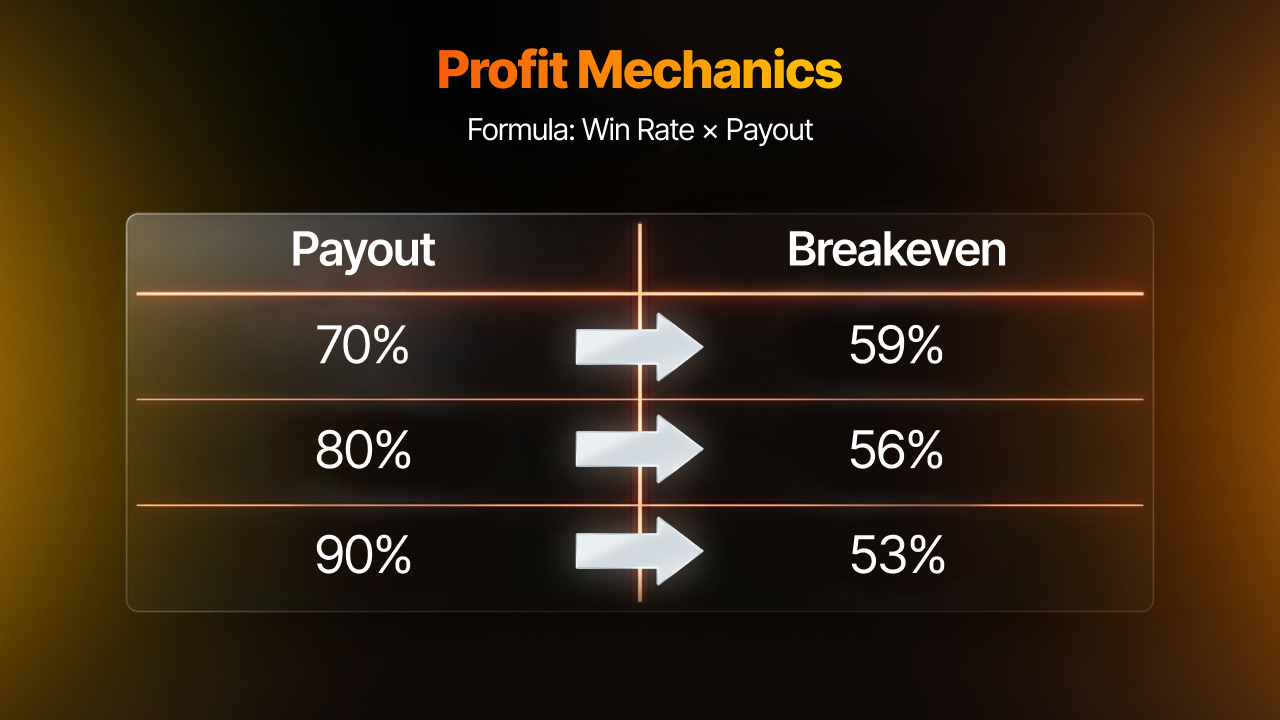
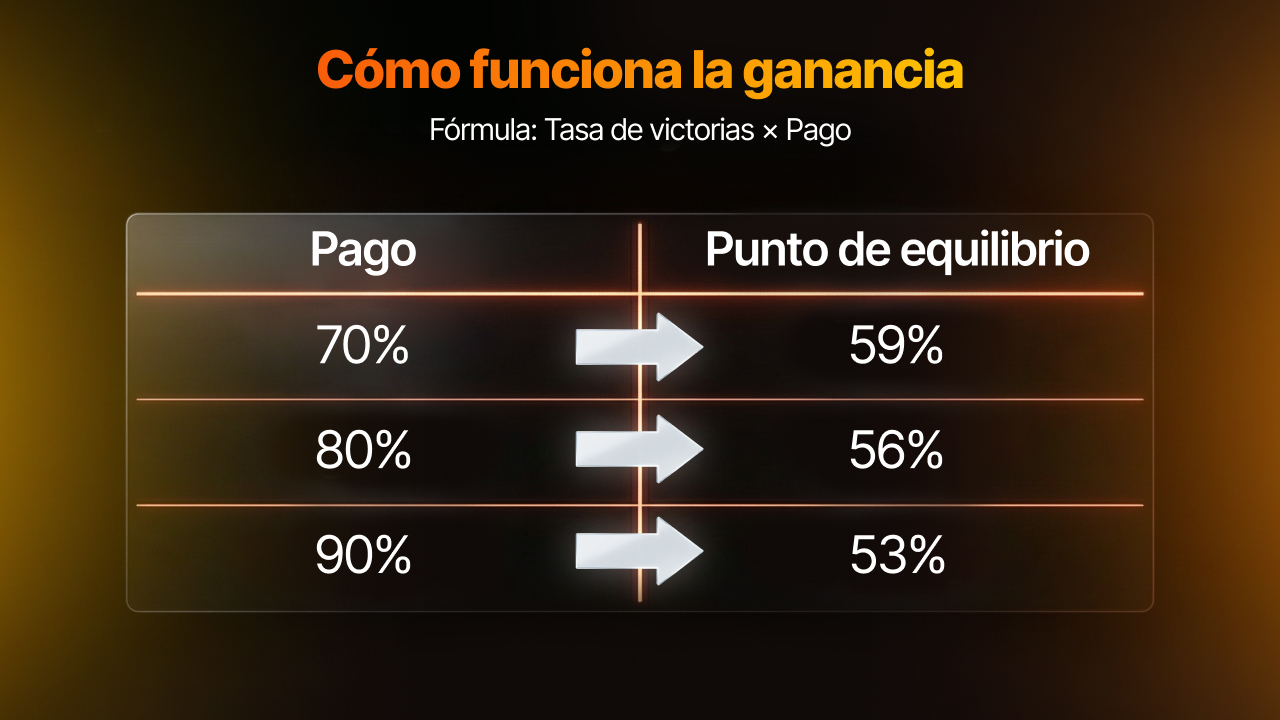
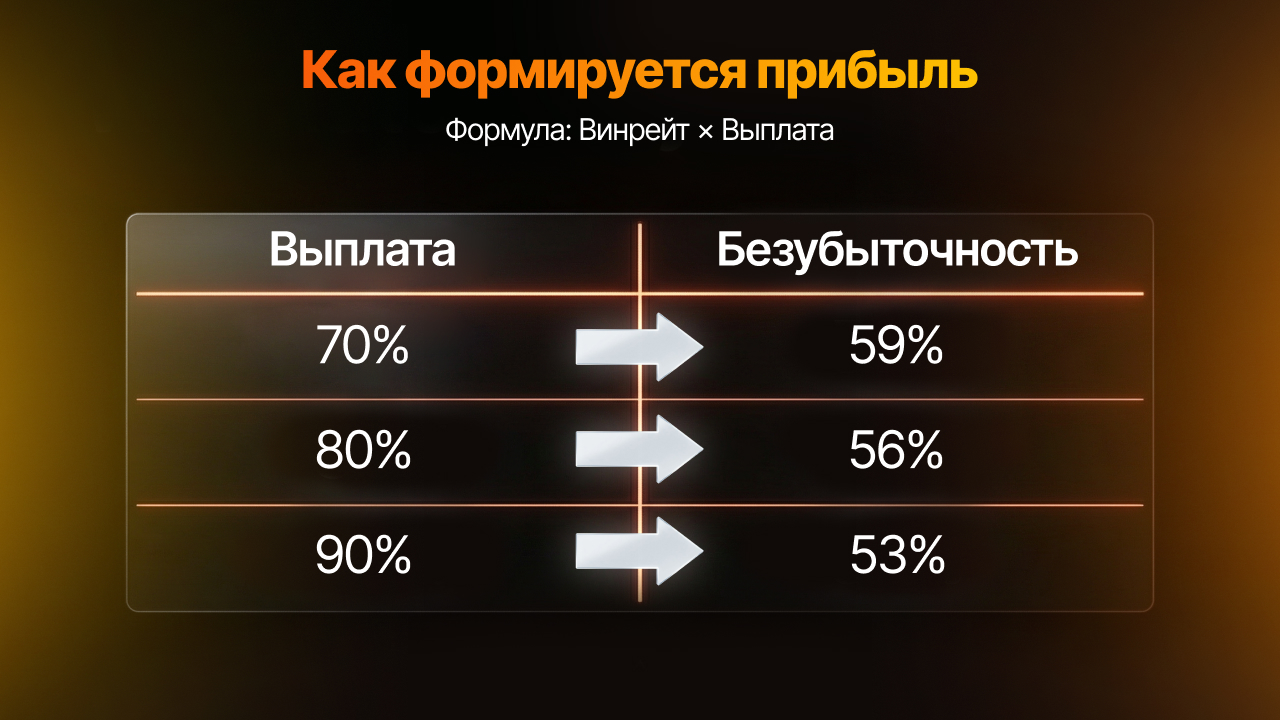
Breakeven Win Rate (Critical Level)
The breakeven win rate is the minimum percentage of winning trades required to avoid losses.
| Payout | Breakeven Win Rate | | 70% | 59% | | 80% | 56% | | 90% | 53% |
This means:
- at 80% payout, you must win more than 56% of trades
- if your win rate is lower → you lose money over time
- if higher → you gain money over time
This is the core reason why many beginners fail. They underestimate how precise their trading needs to be.
Expected Value (Real Profit Formula)
Expected value (EV) is the most important concept in binary options trading.
It measures how much you earn (or lose) on average per trade.
Formula:
EV = (Win Rate × Profit) – (Loss Rate × Loss)
Example:
Win rate: 60% Payout: 80% Risk: $100
EV = (0.6 × 80) – (0.4 × 100) EV = 48 – 40 = +8
This means each trade generates +$8 on average over time.
Over 100 trades → +$800 Over 500 trades → +$4000
If EV is negative, the strategy will lose money regardless of short-term wins.
This is the most direct answer to:
is binary options trading profitable?
Yes — but only when expected value is positive.
Can You Really Make Money With Binary Options?
Yes, but only under specific conditions.
A trader can make money with binary options if:
- trades are based on binary options chart analysis
- expiration matches market conditions
- risk is controlled consistently
- decisions are repeatable
Most beginners fail because they focus on individual outcomes instead of long-term probability.
They ask: “Will this trade win?”
Instead of: “Does this setup have an edge?”
That shift is critical.
Is Binary Options Trading Profitable in Real Life?
Binary options trading is realistic, but not in the way beginners expect.
It is not:
- fast income
- guaranteed profit
- easy money
In real conditions:
- beginners often lose in the early stage
- results improve with experience
- profitability comes from filtering trades, not increasing activity
Consistency matters more than activity.
How Much Can You Realistically Make With Binary Options?

This question depends on expectations.
Realistic profit is determined by:
- account size
- risk per trade
- trade frequency
- consistency
Example:
Account: $1000 Risk: 2% ($20) Payout: 80% Trades per day: 3–5
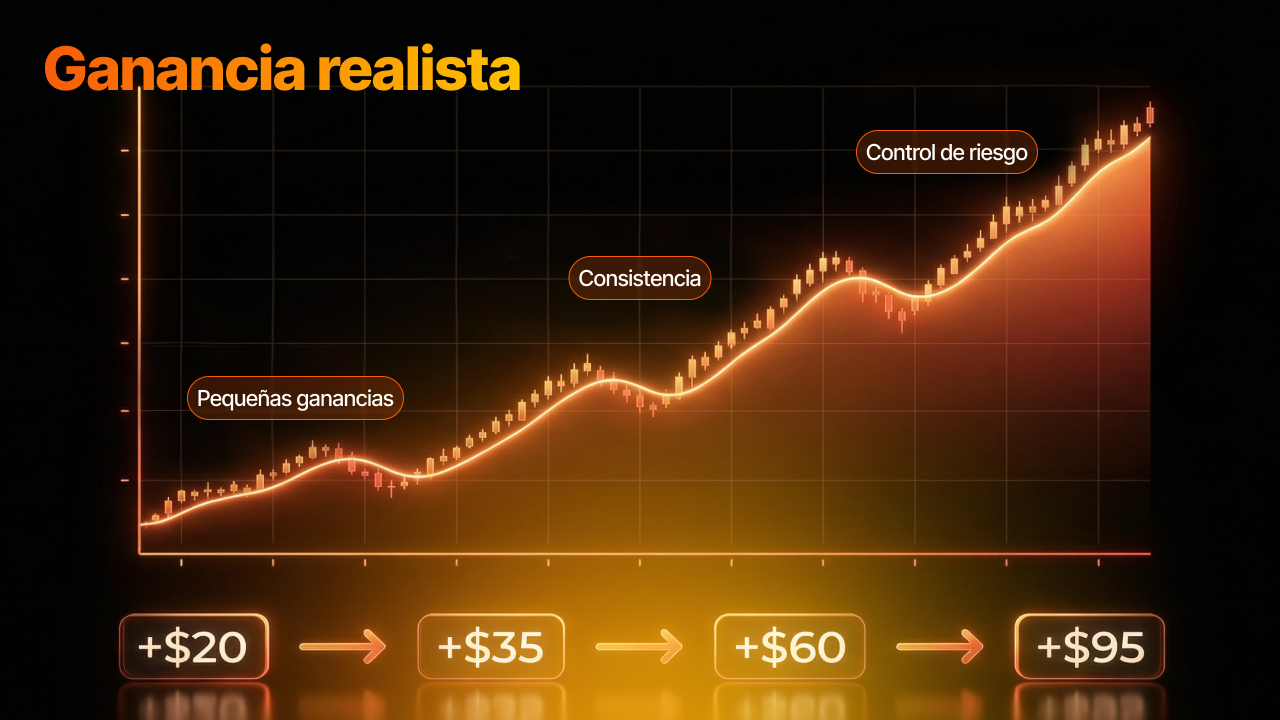
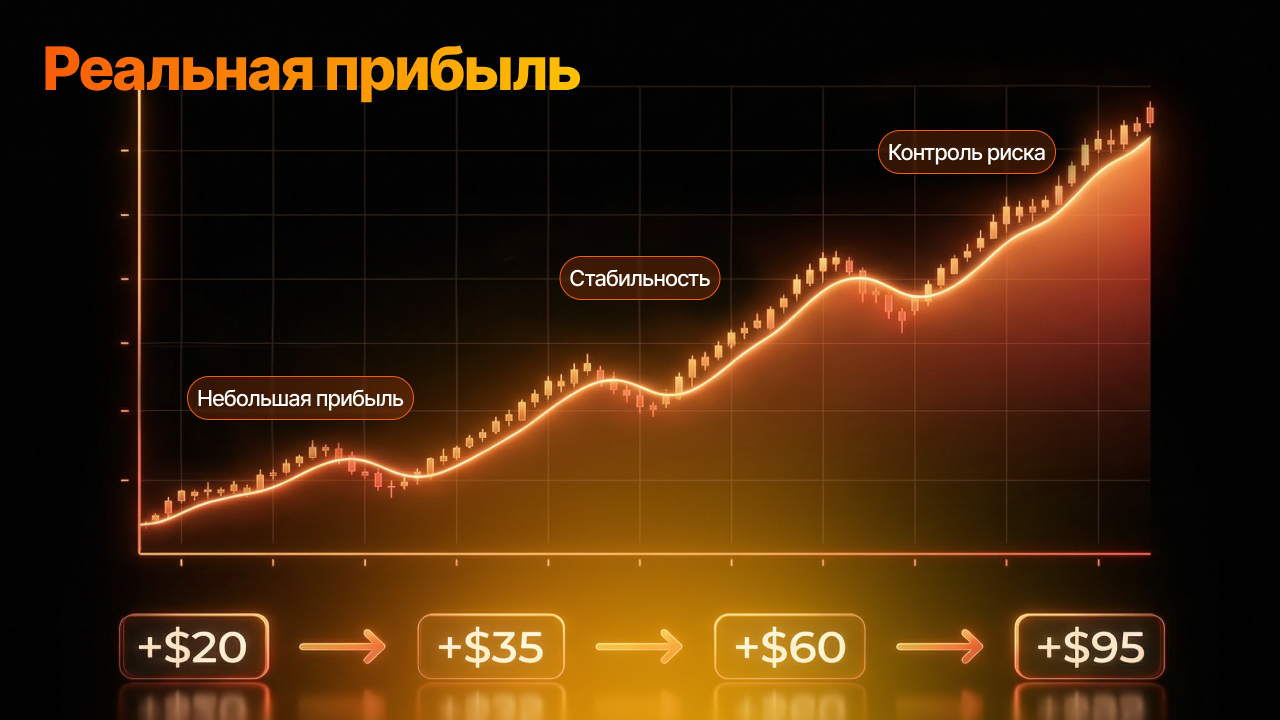
Even with a positive edge, growth is gradual.
Binary options trading is not about doubling capital quickly. It is about maintaining steady performance over time.
Can Beginners Make Money With Binary Options?
Yes, but not immediately.
Most beginners go through predictable stages:
Stage 1 — Random trading Stage 2 — Structured learning Stage 3 — Selective execution
Those who skip learning lose money.
Those who develop skills improve gradually.
Why Many People Fail to Make Money With Binary Options
Most traders fail not because binary options are unprofitable, but because of repeatable mistakes.
Common patterns:
- trading without analysis
- random expiration selection
- trading against market structure
- increasing risk after losses
- overtrading
These mistakes are predictable and widely documented (Common Mistakes in Option Trading and How to Avoid Them).
Another critical issue is misunderstanding probability.
Even profitable strategies produce losing trades. Beginners often abandon working strategies too early.
The Role of Strategy in Profitability
.jpg)
A strategy defines when to trade and when not to trade.
It includes:
- entry conditions
- market environment
- expiration logic
- risk rules
For example, a trend setup may require:
- clear direction
- pullback
- confirmation
Without these conditions, the trade is skipped.
For a deeper breakdown, see (Binary options trading strategies: a structured, numbers-based approach).
Binary Options Chart Analysis and Decision Quality
Binary options chart analysis is the foundation of decision-making.
Without it, trades become random.
Effective analysis includes:
- trend identification
- support/resistance
- momentum
- volatility
If needed, start here (How to Analyze a Chart in Binary Options Trading: A Complete Practical Guide).
Binary Options Risk Management
Risk management determines survival.
Key rule:
- 1–3% risk per trade
- fixed size
- no emotional adjustments
Without this, even good strategies fail.
Binary Options Trading Psychology
Psychology affects execution.
After losses → impulsive trades After wins → overconfidence
Consistency breaks when emotions take control.
What Separates Profitable Traders
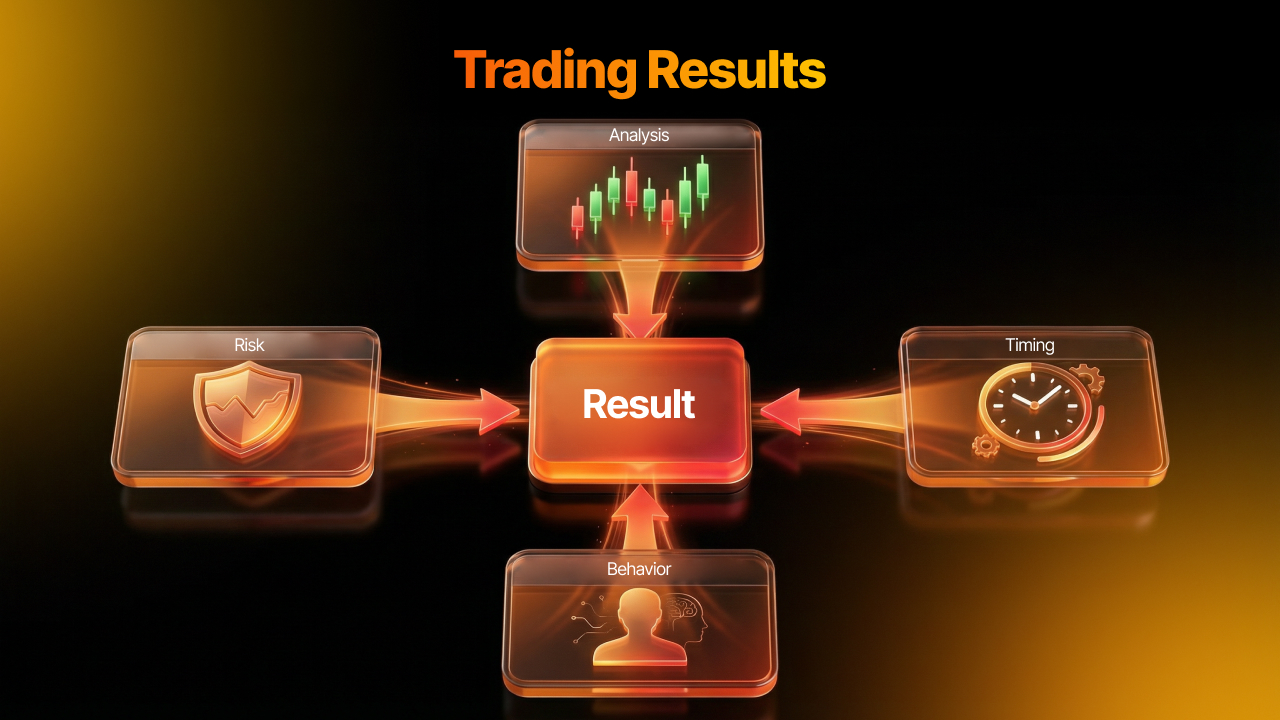
Losing traders:
- chase signals
- trade often
- increase risk
Profitable traders:
- filter setups
- control risk
- review trades
The difference is structure.
Practical Example
Trader A:
- 20 trades
- no rules
Trader B:
- 3–5 trades
- strict criteria
Trader B is more likely to be profitable due to consistency.
How to Increase Your Chances of Making Money
Focus on:
- structured analysis
- trade journaling
- reviewing results
- setup quality
Evaluate decisions, not outcomes.
Practice Before Real Trading
Practice helps build skills.
Use demo trading to:
- test strategies
- understand behavior
- improve execution
Start here (Binary Options Demo Account: How to Practice Properly Before Trading Real Money).
Conclusion
So, can you make money with binary options?
Yes — but only with a structured, probability-based approach.
Binary options trading is profitable when:
- expected value is positive
- risk is controlled
- execution is consistent
It is not a shortcut. It is a skill.
And like any skill, it improves with practice and structure.
Summary By AI
Can you make money with binary options? Yes, it is possible, but only with the right approach. Stable profitability comes not from the simplicity of the instrument, but from a positive Expected Value, proper risk management, and disciplined execution. Beginners often lose because they underestimate the importance of win rate, payout ratio, and the need for a statistical edge. Even with a high payout (e.g. 80%), a trader needs to win more than 56% of trades to break even. Real profit comes gradually through structured chart analysis, strict risk management (1–3% per trade), trade journaling, and filtering high-quality setups. Binary options trading is not quick money — it is a skill that requires time, discipline, and a systematic approach.



.jpg)